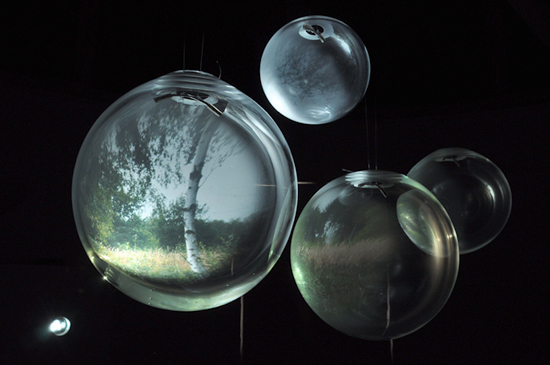
PATTERN COMPLETION (working title), video and sound installation
In collaboration with Hugo Spiers and Tom Simmons; funded by the Wellcome Trust
PROJECT UPDATE OCTOBER 09
PROPOSAL
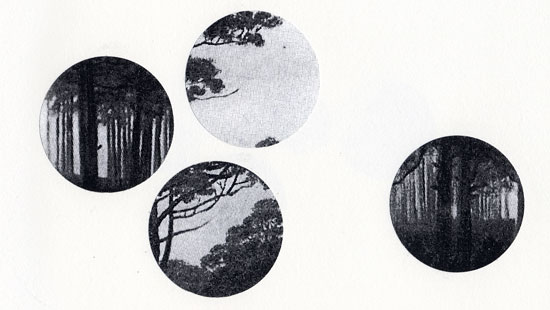
This project brings together a neuroscientist, an artist and a sound designer to develop an installation exploring how networks of brain cells recall memories. Audio-visual sequences will be projected onto a suspended spiral of glass spheres. Initially the images and sounds will be hard to decipher, but as time passes they will become increasingly coherent, following a theoretical process known as pattern completion. The installation will invite the audience to consider how their brain pieces together a memory and the implications this has for how our memories are structured.

Remembering a past event can be trivial or frustratingly hard. This difficulty often depends on how much information we have at hand. Seeing the face of a long absent friend can trigger a memory to resurface or leave us embarrassed as we draw a blank. If we tap into the right information the past can flood back in rich detail. Somewhere in our brain those memories have been unlocked and have entered our consciousness, but how are these memories formed?
The answer lies in the billions of connections between the neurons in our brain. When a memory is created activity patterns in the neurons become inscribed in their connections, leaving a trace known as an engram. It is thought that during recall this trace is re-activated and the original activity pattern re-established. This process is known as ‘pattern completion’ and is believed to occur in a part of the brain called the hippocampus. During pattern completion, the initial activity of the cells is incoherent, but via a repeated re-activation process the activity pattern is pieced together until the original pattern is complete. Sometimes it fails, leaving us unable to bring elements of the past to mind.
This fragmented recall of the past is something that fascinates scientists and artists alike. Differences between subjective and objective approaches, between phenomenological and biological concepts are reflected in creative practices that explore memory. The complex nature of memory, the ambiguities between remembered and imagined events, the ephemeral qualities of our memories, the ways we use our memories to define ourselves are recurring themes in such practices. The combining of sounds and images to evoke sensations of memory or to articulate fragments of lived experiences provides new opportunities to explore these phenomena.
Our project will attempt to bridge this gap, investigating the process of pattern completion and memory fragmentation using sculpture, moving image and sound. It will provide a novel opportunity to explore how the activity in our brain underlies our cognition and feelings.
Hugo Spiers, Michaela Nettell, Tom Simmons, July 2008